
The 2024 Alba white truffle auction reached record prices: a single 510-gram specimen sold for 124,000 euros at the Castello di Grinzane Cavour. The headlines that followed mostly described the result as a milestone for Italian luxury food. The harder story underneath the auction prices is that the supply of white truffles has been declining for two decades, that climate pressures are reshaping the entire fungal ecosystem on which the industry depends, and that counterfeit and fraudulent truffle products have become a substantial parallel economy. The Italian truffle industry in 2026 is simultaneously more economically valuable than ever in nominal terms and more structurally fragile than at any point in modern memory.
This piece works through what the Italian truffle economy actually looks like in 2026: the harvest realities, the climate pressures, the regional industry structure, the persistent counterfeit problems, and the prices that working chefs and consumers are negotiating with this season.
The basic biology and what is changing
The Italian white truffle, Tuber magnatum Pico, is a subterranean fungus that grows in mycorrhizal association with specific tree species — primarily oak (Quercus), poplar (Populus), willow (Salix) and lime (Tilia). The fungus produces fruiting bodies (the truffles themselves) below ground in autumn, typically from late September through January. The white truffle has resisted serious cultivation despite decades of research, unlike its cousin the black Périgord truffle (Tuber melanosporum) which is now successfully cultivated in inoculated truffle orchards.
The supply is consequently entirely wild-harvested, and the harvest depends on a combination of summer rainfall, autumn temperatures, soil moisture, forest health and the ongoing presence of mature host trees. Several of these variables have shifted measurably over the past three decades. The 2023 paper by Marco Iotti and colleagues in Mycologia documented declining yields in traditional production zones across northern Italy, with the fall traceable primarily to climate variables: reduced summer rainfall in some regions, increased temperature variability, and changes in the seasonal timing that affect fruiting body development.
The 2024 harvest, by most regional estimates, was approximately 60 percent of the 2010 harvest in the same areas, with the trend more or less continuous across the period.
The Alba phenomenon
The town of Alba in the Piedmont region has been the international centre of the white truffle market for nearly a century. The Fiera Internazionale del Tartufo Bianco d’Alba, running annually since 1928, has expanded into a substantial October-to-December seasonal economy that draws international buyers, restaurant chefs and gastronomic tourists. The 2024 fair drew approximately 200,000 visitors to a town of roughly 30,000 residents.
The Alba market does not actually produce most of its white truffles from the immediate Alba area. The truffle territory of the Langhe and Roero hills produces a portion of the market’s supply, but substantial quantities are sourced from the broader Piedmont region (including the Monferrato), from Tuscany and Umbria (where the white truffle also grows), and from Croatia and other countries where the same species occurs. The Alba branding effectively concentrates the entire Tuber magnatum trade through the Piedmont commercial infrastructure.
This concentration has economic implications. Truffles harvested in Croatia and sold through Alba command Alba prices, which are substantially higher than direct-from-source pricing. The premium reflects partly the trading and quality-grading infrastructure of Alba, partly the marketing advantage of the Piedmont brand.
The regional truffle map
Italy supports significant truffle production across multiple regions, with each producing somewhat different species mix and seasonal patterns.
Piedmont
The Langhe, Roero and Monferrato hills are the most famous white truffle territory globally. The Alba auction sets the seasonal price ceiling for white truffles. Beyond the white truffle, Piedmont also produces black summer truffles (Tuber aestivum) and other minor species.
Umbria and Le Marche
Umbria, particularly the Norcia, Spoleto and Gubbio areas, produces both white and black truffles in substantial quantities. The Umbrian black truffle (Tuber melanosporum) is generally considered comparable in quality to the more famous Périgord truffles of France. The Le Marche region, particularly Acqualagna, has its own white truffle harvest and a traditional October-to-November fair that runs alongside the Alba market.
Tuscany
Tuscany produces both white truffles (in the Crete Senesi, the area around San Miniato, and the Mugello) and substantial black summer truffles. The San Miniato white truffle fair in November is the most important Tuscan truffle event.
Abruzzo and Molise
Abruzzo and Molise produce substantial summer black truffles and some white truffles in higher elevations. The truffle economy in these regions is less internationally marketed than in Piedmont and Umbria but remains commercially important.
Emilia-Romagna and Veneto
The northern Apennine foothills produce a smaller volume of white truffles, primarily traded through regional channels rather than international markets.
The price reality
White truffle prices in 2024-25 ran approximately 4,000 to 6,000 EUR per kilogram for restaurant-quality specimens at wholesale, with retail prices for high-quality consumer purchases typically reaching 7,000 to 10,000 EUR per kilogram. Top auction lots reach much higher prices but represent the extreme end of the market rather than the working economy.
Black truffle prices are substantially lower. The Périgord-equivalent Tuber melanosporum in winter typically runs 1,500 to 3,500 EUR per kilogram. Summer black truffles (Tuber aestivum) run 200 to 500 EUR per kilogram. Bianchetti or marzuoli (Tuber borchii), spring white truffles often confused with the more valuable autumn white truffle, run approximately 300 to 800 EUR per kilogram and represent one of the more common substitution substitutions in fraud cases.
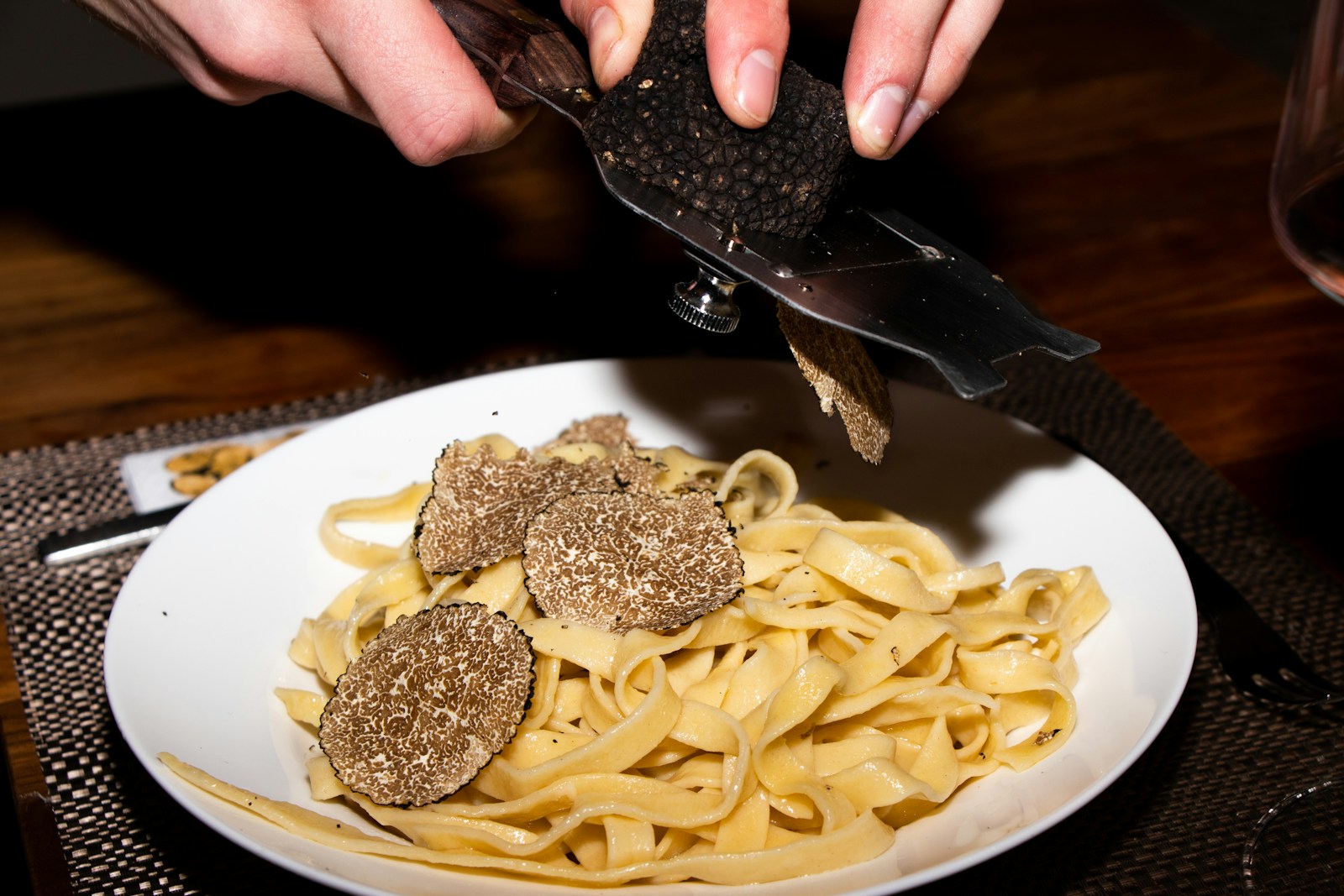
For restaurant pricing, a generous shaving of white truffle over a pasta course typically uses 8 to 12 grams of fresh truffle, which costs the restaurant approximately 35 to 75 EUR at wholesale. The retail price markup on truffle dishes is consequently substantial; truffle-shaved pasta dishes at high-end restaurants in Alba and Milan during peak season typically run 60 to 120 EUR.
The counterfeit problem
The economic gap between white truffles and cheaper alternatives has produced one of the more persistent fraud problems in European luxury food. Several specific patterns recur.
Species substitution
The most common fraud is substituting Tuber borchii (the spring white truffle, also called bianchetto) for autumn white truffles. The two species are visually similar but the bianchetto’s flavour is substantially less intense and the wholesale price is roughly one-tenth that of Tuber magnatum. The substitution requires no chemical treatment; the truffles can simply be sold as autumn white truffles to inexperienced buyers.
Geographic substitution
White truffles harvested in Croatia, Romania or Iran (where Tuber magnatum also grows naturally) are sometimes sold as Italian. The price differential is substantial — the species is the same but Italian provenance commands a 30 to 60 percent premium. Without chemical or genetic testing, the geographic provenance cannot be verified after harvest.
Truffle product fraud
Truffle oil is the most consistently fraudulent product in the broader category. Most “truffle oil” sold in commercial channels contains no truffle at all, with the characteristic aroma produced synthetically using 2,4-dithiapentane, the dominant aromatic compound in Tuber magnatum. The synthetic compound is approved for food use and the product is not technically illegal, but the labelling often misleads consumers into believing they are buying a natural extract.
Truffle butters, truffle salts and truffle creams are similarly often produced with synthetic flavouring rather than actual truffles. Genuine truffle products, made with fresh or properly preserved truffles, tend to be substantially more expensive (typically 5 to 10 times the price of synthetic alternatives) and are sold by smaller specialist producers.
The hunting practice
Truffle hunting in Italy is regulated by regional authorities, with hunters typically required to hold permits and to undergo periodic training and re-certification. The hunters work primarily in early morning and evening hours, with their dogs (almost universally Lagotto Romagnolo, an Italian breed specifically developed for truffle hunting). The dogs are trained to find truffles by scent and to indicate their location without damaging the specimens.
The hunting practice involves substantial regional knowledge. Productive truffle areas (tartufaie) are often known to specific hunters and passed down through families across generations. The economic value of detailed forest knowledge has made the hunters’ practical expertise a substantial professional asset, though the work itself is typically modestly paid (most hunters sell to intermediaries who handle the actual market sales).
The 2021 UNESCO recognition of Italian truffle hunting as Intangible Cultural Heritage acknowledged the cultural significance of the practice and provided some institutional support for its preservation. The recognition also brought greater public attention to the hunters’ work and the conservation challenges facing the broader truffle ecosystem.
What the future probably holds
Several trends are likely to shape the Italian truffle economy across the coming decade.
Climate pressure on white truffle production is unlikely to reverse. The most likely outcome is a continued gradual decline in supply, supporting continued price increases that will increasingly limit truffle consumption to the upper end of the restaurant and consumer markets.
Successful cultivation of Tuber magnatum remains an open research goal but has not been achieved at commercial scale despite decades of work. If a cultivation breakthrough occurs, it would dramatically change the supply economics; without it, the wild-harvested constraint will continue to define the market.
Anti-fraud measures, including DNA testing and origin certification programmes, are likely to expand. Several Italian regional governments and trade associations have invested in genetic verification systems, with the Alba region implementing the most comprehensive certification structure to date.
Climate adaptation strategies, including identifying and protecting new productive territories as climate shifts existing ones, are receiving research investment. The University of Turin’s truffle research group has been particularly active in mapping potential future production zones.
What home cooks should know
For home cooks interested in cooking with white truffles, several practical points apply. Buy fresh truffles only during the active season (October through January for white truffle), preferably from established specialist suppliers who can document provenance. Expect substantial expense; a 30-gram specimen suitable for two pasta courses for two people will cost 80-150 EUR.
Use truffles immediately. Fresh truffles lose aromatic intensity rapidly after harvest and are best used within five days. Storage in airtight containers with rice has historically been recommended, though recent research suggests this technique offers more aesthetic than practical benefit.
Pair truffles with simple vehicles. The classic pairings — fresh egg pasta, soft-cooked eggs, risotto — work because they provide neutral fat-rich substrates that carry the aromatic compounds without competing flavours. More elaborate dishes typically dilute rather than enhance the truffle.
The Lagotto Romagnolo: the dog that defines the trade
The Lagotto Romagnolo is the only dog breed officially recognised internationally as a truffle hunting specialist. The breed originated in the Romagna region as water retrievers in the marshes around Ravenna and the Comacchio lagoons, and was redirected toward truffle hunting in the late nineteenth century as wetland drainage reduced the demand for water dogs. The breed’s combination of strong scenting ability, controlled energy, and trainability made it remarkably well-suited to the work.
A trained adult Lagotto Romagnolo represents substantial investment for a working hunter. Puppies from established working bloodlines cost 1,500 to 3,500 EUR. Training to operational standard typically requires 18 to 24 months of consistent work, and the dog’s productive working life runs roughly 8 to 12 years depending on health and conditions. The total economic investment in a working dog over its career, including food, veterinary care and training, runs 8,000 to 15,000 EUR. Established hunters typically maintain two or three dogs at different career stages to ensure continuity of operations.
Several Italian breeding programmes maintain working bloodlines specifically selected for truffle hunting ability rather than show characteristics. The Italian Kennel Club’s working line registrations are smaller than show line registrations but produce dogs with substantially better hunting performance. Working hunters typically source from these specialised programmes rather than from general Lagotto breeders.
The breed has expanded substantially in non-working contexts in the past two decades, with Lagotti now common as family pets across Europe and North America. The hunting bloodlines remain a smaller specialised population, with breeders typically reluctant to sell to non-hunters because the dogs’ genetic temperament suits working contexts better than urban pet life.
The trifolau code: ethics and forest management
The Italian truffle hunters (trifolau in Piedmontese, tartufai elsewhere) operate under a substantial unwritten code that governs forest access, share with landowners, dog welfare, and forest stewardship. The code has developed over generations of practice and is now partially codified in regional regulations across the major truffle territories.
The most fundamental element is forest stewardship. Truffle hunters know that the productivity of a tartufaia depends on long-term forest health, and the most experienced hunters actively maintain the host trees, manage soil conditions, and avoid over-harvesting in any single season. Several traditional practices — replanting acorns from productive trees, leaving sufficient ground cover, avoiding mechanical disturbance of the soil — collectively support continued productivity across decades.
The relationship with landowners is similarly governed by traditional practice. Most truffles in Italy are harvested on private land with the landowner’s permission, with shares of the harvest typically going to both the landowner and the hunter. The exact splits vary by region and tradition, but a common pattern is a 50-50 split with the hunter providing the labour, dog and equipment.
The 2024 reform of Italian truffle regulation, codified in Decreto Legislativo 39/2024, has formalised several of these traditional arrangements while adding licensing requirements, harvest quotas in stressed regions, and forest protection requirements. The reform has been controversial among traditional hunters, some of whom feel the formalisation reduces flexibility, while others welcome the institutional support for sustainable practice.
Misconceptions about Italian truffles
Several common misconceptions about Italian truffles deserve correction. The first is that all white truffles are from Alba. They are not. Substantial white truffle production occurs in Umbria, Tuscany, the Marche, Molise and Abruzzo, with quality comparable to the Piedmont harvest. The Alba branding is a marketing position rather than a unique geographic claim about quality.
The second misconception is that black truffles are inferior to white truffles. They are different rather than inferior. The black Périgord truffle (Tuber melanosporum) has a fundamentally different aromatic profile and culinary use than the white truffle, with substantial heat tolerance that allows incorporation into cooked dishes (the white truffle’s aromatic compounds are largely destroyed by heat). Several traditional Italian preparations use black truffle specifically because the white truffle’s aromatic delicacy would be wasted.
The third misconception is that truffles are uniformly priced based on weight. Truffle pricing is more complex, with substantial premiums for specific qualities including aromatic intensity, surface integrity, freshness, geographical provenance, and the season’s overall scarcity. A 50-gram truffle of exceptional quality may sell for substantially more than a 100-gram truffle of more typical quality. Working buyers grade individual specimens rather than buying purely by weight.
The fourth is that truffle products at supermarket prices contain real truffle. Most do not. The synthetic 2,4-dithiapentane production cost is so much lower than real truffle that the substitution is essentially universal at lower price points. A “truffle oil” sold for 8 EUR is almost certainly synthetic regardless of the labelling; genuine truffle products start at substantially higher price points and are typically sold by specialist suppliers rather than supermarkets.
How to source genuine truffle products
For consumers wanting to purchase genuine truffle products, several specific sourcing strategies work better than the generic options. The Tartufi Morra company in Alba, founded in 1930, produces a range of truffle products with verifiable truffle content; their truffle butter, truffle salsa and preserved white truffle are reliable. The Urbani Tartufi company has similarly maintained genuine production standards across a substantial product range. The Antonio Carluccio brand in the UK (despite the founder’s death) continues to produce authentic Italian truffle products through partnerships with genuine Italian producers.
For fresh truffle, direct purchase during the season from established suppliers is the most reliable approach. The Alba market itself accepts public visitors during the autumn fair, with vendor verification by the regional authority providing some protection against the most basic fraud. Several specialist online suppliers including Plantin France (despite the French focus, they handle Italian truffles), Truffle Hunter UK, and several Italian direct suppliers (Tartufi Morra, Urbani, Sabatino Tartufi) offer fresh truffle direct shipping during the season.
For travellers visiting Italy during truffle season, several specific markets offer reliable purchasing opportunities. The Alba truffle market runs each weekend from late September through December and includes vendor verification. The Acqualagna market in the Marche runs in October-November. The San Miniato market in Tuscany runs across November. Each provides specialist vendors with reasonable provenance documentation, though prices are typically higher than direct hunter sales would be.
The chef’s perspective
Working chefs at high-end Italian restaurants negotiate complex relationships with the truffle economy. The seasonal availability and price volatility of fresh truffles affects menu planning across the autumn-winter season, and several restaurants build their menus specifically around the truffle calendar. The most experienced chefs typically maintain relationships with specific Alba or regional suppliers across multiple years, accepting some pricing volatility in exchange for consistent quality and reliable supply during scarcity periods.
Top restaurants typically use 4 to 8 grams of fresh white truffle per shaved-truffle dish, depending on the customer-facing pricing strategy. The cost of the truffle alone in such a dish runs 18 to 50 EUR depending on seasonal pricing. The retail menu price typically marks up by a factor of three to five times the truffle cost to cover the broader plate cost, restaurant overhead and reasonable margin.
Several leading Italian chefs including Massimo Bottura, Enrico Crippa and the late Gualtiero Marchesi have produced substantial bodies of culinary work specifically engaging with the truffle tradition. The Crippa restaurant Piazza Duomo in Alba is particularly notable for its sustained engagement with regional truffle preparation, often serving white truffle in unconventional preparations that explore the ingredient’s aromatic range beyond the standard pasta and egg pairings.
Further reading
The Wikipedia entry on Tuber magnatum provides biological background. The UNESCO intangible heritage citation for Italian truffle hunting provides cultural context. The New York Times Food section publishes extensive coverage of the Italian truffle market each autumn, including specific reporting on the Alba auction results and seasonal availability. Our archive on regional Italian markets is at mercato dei sapori, with broader artisan products at prodotti artigianali, and a separate thread on Italian fungi covering the broader mycological tradition.
This article is for informational purposes and reflects publicly available agricultural and commercial information; truffle prices and supply vary substantially season to season, so verify current details with specialist suppliers for any specific purchases.